





 4.5/5
4.5/5 火 火
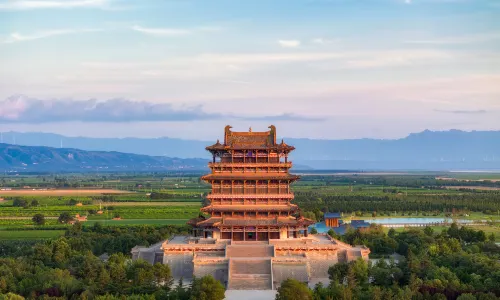
火 火The Yellow River scenic spot is located on the east bank of the Yellow River west of the ancient city of Zhangzhou, Yongji City, Shanxi Province. It is one of the four famous buildings in ancient China, and is famous for the Yellow Crane Tower, Yueyang Tower and Tengwang Pavilion. The building was built in the Northern Zhou Dynasty (557-581), and was built by General Yu Wenhu of the Northern Zhou Dynasty. It was originally a military building. Because there were birds inhabiting it, it was named "the ". It has been through the Tang and Song dynasties, and it has been around for more than 700 years. It was destroyed in the early years of the Yuan Dynasty. In 1997, the building began to be rebuilt and officially opened to visitors in 2002. After the renovation, the building was a Tang Gaotai pavilion, with four or three floors in appearance, six floors in interior, and a total height of 73.9 meters. The building was decorated with Tang Dynasty paint and color paintings, and the oil painting area reached more than 30,000 square meters, and the pattern was gorgeous and gorgeous. The building is based on the theme of Yellow River culture and Hedong culture, and shows historical allusions such as ploughing Lishan Mountain and Daqi Zhishui through colored European plastic murals and reliefs. The scenic spot is divided into famous building tourist area, Yellow River style tourist area, landscape tour area and recreational tour area. Among them, the famous building tour area includes the Gate Hall, Yuying Lake and Tangyun Square; the Yellow River style tour area has Zhangzhou style garden, Yellow River style museum and so on. Ticket prices: 54 yuan for the peak season (April 1st to October 31st), 45 yuan for the off-season (November 1st to March 31st). Opening hours: peak season 8:30—18:00, off-season 9:00—17:00.
 4.4/5火 火
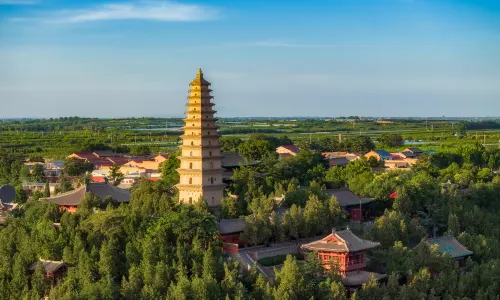
Pujiu Temple is located in Shantou, 3 kilometers east of the ancient city of Zhangzhou, Yunji City, Shanxi Province. It is a long-standing Buddhist Shifang Temple and is also the place where the love story of the classic drama "Xixiang Ji" is born. Pujiu Temple was built in the Sui and Tang Dynasties and has a history of more than 1,000 years. Originally called "Yongqing Courtyard", it is a Buddhist Shifang Temple. During the five generations and ten kingdoms, because the later Han General Guo Wei listened to the suggestions of the monks in the temple, he quickly decided to attack the city of Zhangzhou and rescue the people in the city. The monastery was renamed "Pujiu Temple". The layout of the temple building is three floors above and below, three axes in the east, middle and west. The west axis is the architectural style of the Tang Dynasty, with the Big Bell Tower, the Pagoda, the Louvre, the Wild Goose Pagoda, the Daxiong Palace, etc.; the central axis is the architectural style of the Song and Jin two generations, including the Temple of Heavenly Kings, Bodhisattva Cave, the Mituo Palace, the Luohan Hall, the Ten King Hall, the Tibetan Jing Pavilion, etc.; the East axis is the Ming and Qing shape, with monks and dead wood halls. Yanta: The Yanta in the temple was built in Ming Jiajing 43 years (1564), more than 400 years of history, the tower is39.5 meters high, 13 floors. The tower is known for its strange structure and obvious echo effects. Tourists hit the side of the tower with stones, and the tower will make a crisp and pleasant howling, known as the "pure rescue sound", which is one of the eight scenes of Yongji in ancient times. Back garden: The back garden is a lively garden garden, the park is stacked with stone rockery hanging dangerous like cutting, slang double pavilion moths. The cross-framed winding bridge on the lotus pond, the pavilion bridge is connected, and the lake and mountain are connected. The "bay platform" of the cypress is hidden in the green pine and green cypress, and the bamboo is repaired in the thousands. The attractions related to "Xixiang Ji": There is Zhang Sheng's "Xixiang" in the temple, Cui Wei's "Lihua Deep Courtyard" for a sojourner, and Zhang Sheng's "Shuzhai Yard" after the release of Baima. These attractions are closely connected with the plots in "Xixiang Ji". Ticket price: 50 yuan. Opening hours: peak season (April 1st - October 31st) 08:30—18:00; off-season (November 1st - March 31st) 09:00—17:00.
 No. 1 of Family-friendly Attractions in Yongji

 Half-Price Tickets for Three Major Attractions with the Yongji Water Train | Aug 1, 2025-Dec 31, 2025