Cross-border travel from Hong Kong has never been easier. In 2026, the "Vibrant Express" and the vast China High-Speed Rail network offer the ultimate seamless link to the Mainland. While First Class gets the glory, China Bullet Train Second Class remains the smartest choice for value-conscious travelers—provided you know the insider tricks.
From navigating the 3+2 seat layout to utilizing the new "Quiet Carriages" for a peaceful journey, this guide breaks down everything you need to know. We will even show you how to order hot food delivery right to your seat. Ready to start your journey? Skip the complications and book your high-speed rail tickets directly on Trip.com for instant confirmation and the best rates.
What is China Bullet Train Second Class Like?
When you step onto a China High-Speed Rail (CHSR) train, forget everything you know about cramped economy airline cabins. Second Class on these bullet trains is spacious, clean, and designed for efficiency. However, the layout can be confusing for first-time travelers.
The Layout (3+2 Configuration)
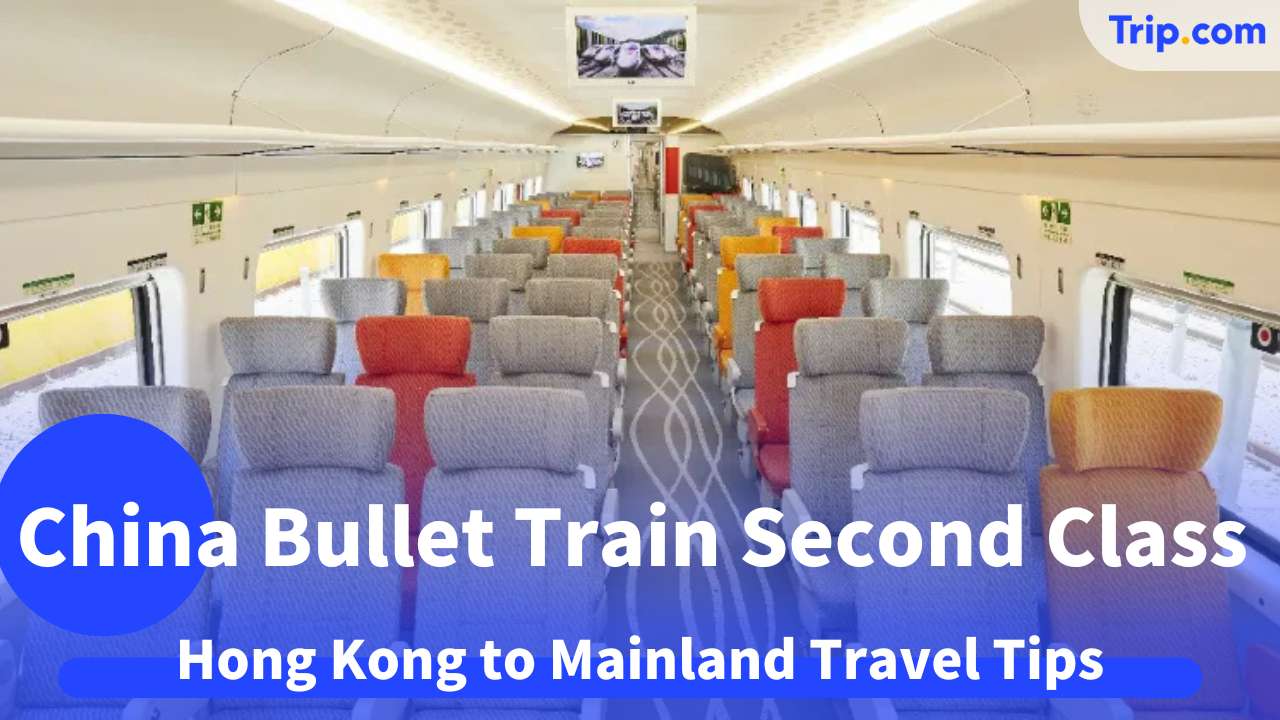
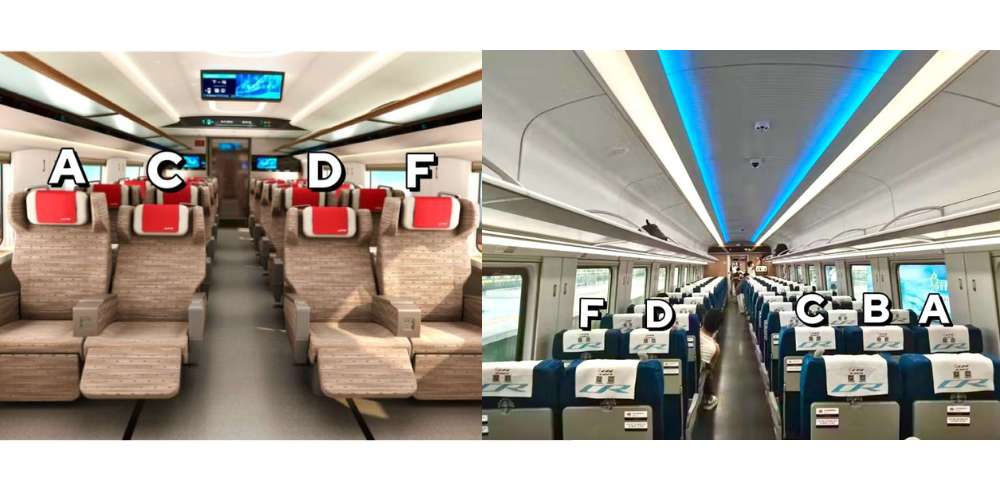
The defining feature of China bullet train second class is its seating configuration. Unlike the 2+2 layout of First Class, Second Class operates on a 3+2 layout.
The ABC / DF Configuration:
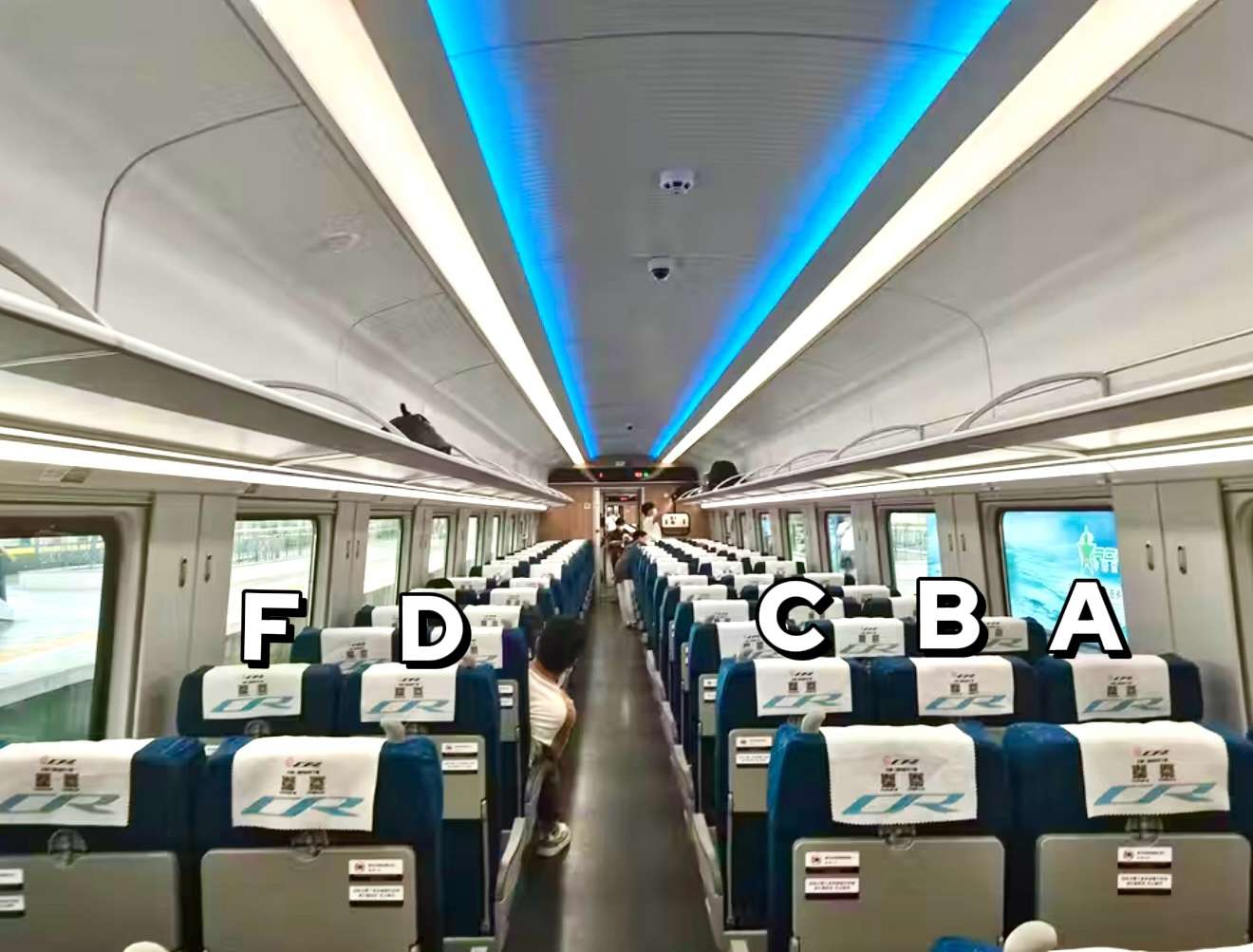
China Train Seat Interior | Second Class
- Side 1 (Three Seats): Labeled A, B, C.
- A: Window seat (Great views, wall to lean on).
- B: Middle seat (The least desirable option; avoid unless the train is fully booked).
- C: Aisle seat (Good for legroom and easy access to the toilet).
- Side 2 (Two Seats): Labeled D, F.
- D: Aisle seat.
- F: Window seat.
Pro Tip for Couples and Solo Travelers:
If you are traveling as a pair, the "two-seater" side (seats D and F) is the golden ticket. You get the privacy of your own row without a stranger in the middle. For solo travelers who value privacy, seat F is widely considered the best seat in Second Class—you have a window, no middle seat neighbor, and fewer people climbing over you.
Comfort & Legroom
Is it cramped? In a word: No. The "Second Class" designation is a misnomer; it is functionally equivalent to Premium Economy on a standard international flight.
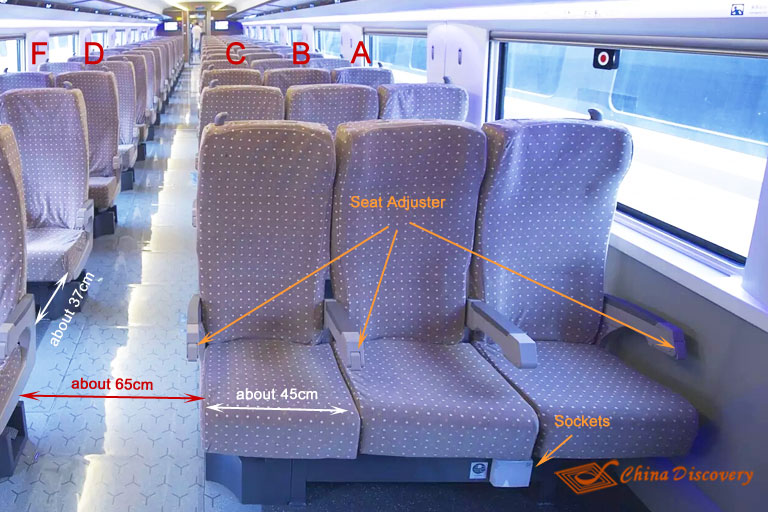
- Seat Pitch: You can expect a generous seat pitch of approximately 45cm. Even if you are over 6 feet tall, your knees will rarely touch the seat in front of you.

Source: China Discovery
- Recline: Seats have a distinct recline functionality. Unlike airplane seats that slide forward, these seatbacks actually tilt back. The etiquette here is key: always glance behind you before reclining to ensure you aren't smashing someone's laptop.

Source: China Discovery
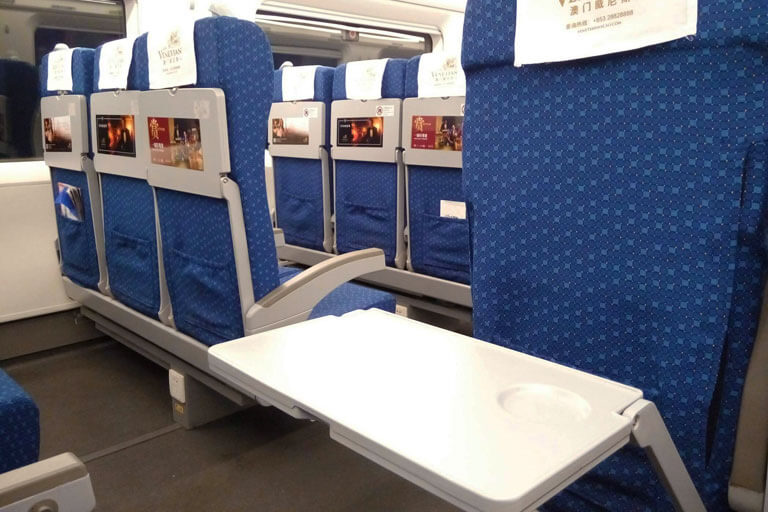
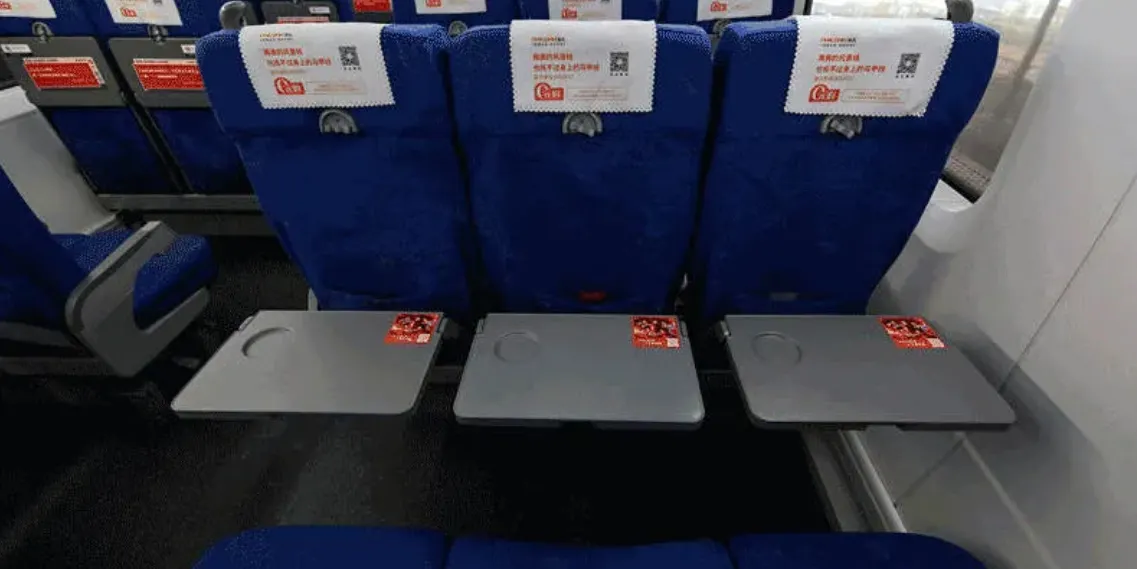
- Tray Tables: Sturdy, drop-down tray tables are standard. They are large enough to hold a 15-inch laptop or a full bento box meal.

China Bullet Train Second Class Seat Map
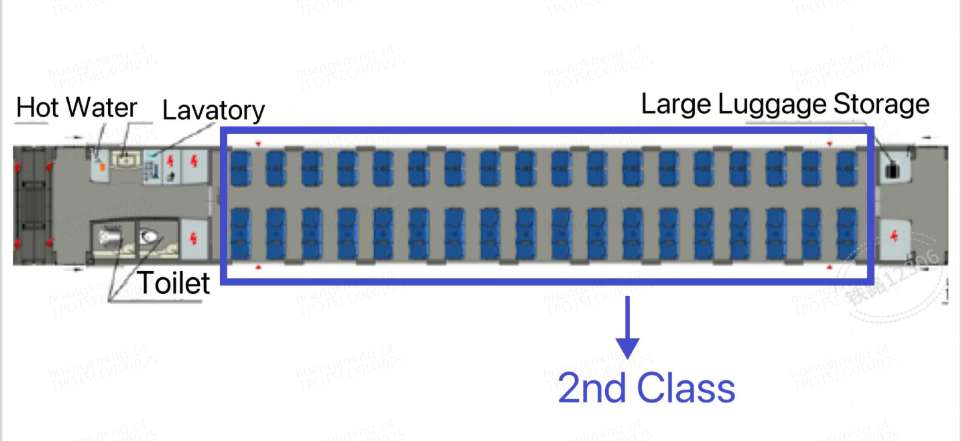
Imagine walking down the aisle. To your left, you see a row of three seats (A-Window, B-Middle, C-Aisle). To your right, a row of two seats (D-Aisle, F-Window). Above, spacious overhead bins run the length of the carriage. This pattern repeats for roughly 15-18 rows. The very first and last rows often have slightly more legroom but are close to the automatic doors, which can be noisy.
Source: 12306.com
Amenities: Power Outlets, Wi-Fi, and Storage
Power Outlets:
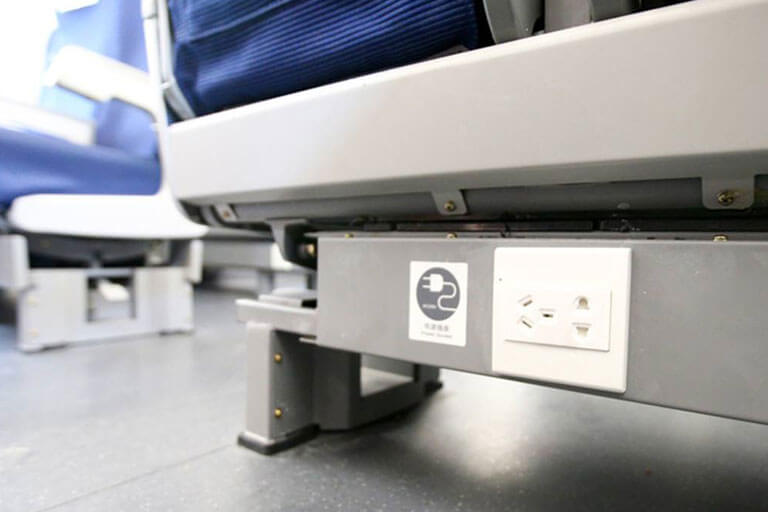
Staying charged is essential. The anxiety of a dying battery is virtually non-existent on these trains if you know where to look.
Source: China Discovery
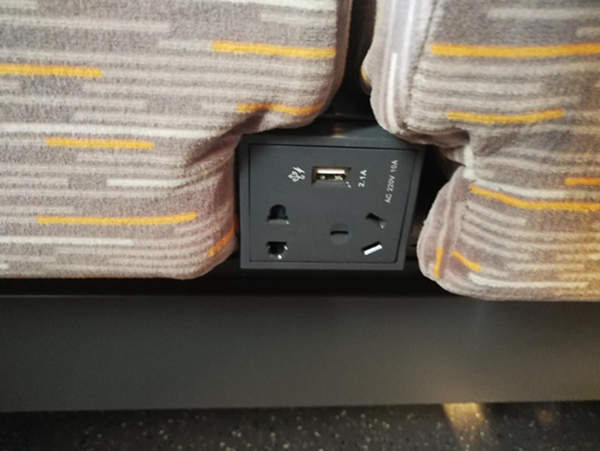
- Location: This is the most common question. In Second Class, the outlets are typically located under the seat cushion, between the seats. You will have to reach down blindly to find them.
- On the 3-seat side (ABC), there are usually two outlets shared among three passengers.
- On the 2-seat side (DF), there is one outlet shared between two passengers.
- Socket Type: Modern Fuxing trains are equipped with multi-standard sockets that accept the 2-pin (Type A/C) and 3-pin (Type I - typical Mainland/Australian) plugs. Most importantly, newer trains now feature direct USB-A and USB-C charging ports, saving you if you forgot your adapter.

Wi-Fi Connectivity:
- The Reality: While trains advertise free Wi-Fi (often named "MTR Free Wi-Fi" on the Vibrant Express or "Go-Fuxing" on Mainland trains), connecting can be tricky.
- The Verification Hurdle: To access the Wi-Fi on Mainland trains, you typically need a Mainland Chinese phone number to receive an SMS verification code. If you are using a Hong Kong SIM with roaming data, it is often faster and more secure to stick to your own 5G/4G hotspot, which works reliably along most tracks.
Luggage Space:

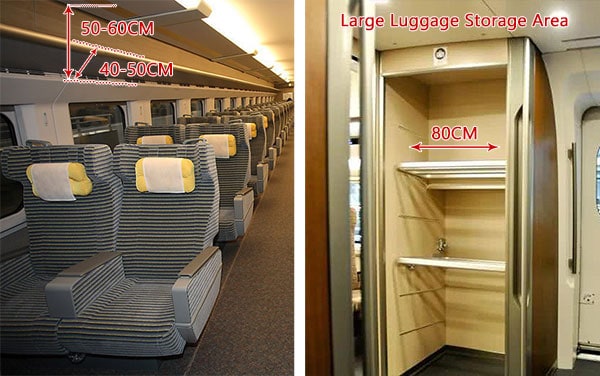
- Overhead Racks: These are open shelves, not closed bins. They can comfortably fit 24-inch suitcases and backpacks.
- Luggage Closets: For larger items (28-inch+ suitcases), you must use the designated luggage closets located at the connection ends of each carriage.
- Behind the Last Row: A secret storage spot! If you are in the very last row of a carriage, there is often a generous gap behind your seat and the carriage wall perfect for stowing a large trunk.
China High Speed Rail First Class vs Second Class: Is the Upgrade Worth It?
One of the most frequent debates for travelers is whether the price jump to First Class is justified. Let’s break it down using the core keyword: China high speed rail first class vs second class.
Comparison: Price vs. Space vs. Noise
Feature | Second Class | First Class |
|---|---|---|
Configuration | 3 + 2 (5 seats per row) | 2 + 2 (4 seats per row) |
Seat Width | Approx. 43 cm | Approx. 47.5 cm |
Legroom | Good (85-90 cm) | Excellent (100-110 cm) |
Price Factor | 1.0x (Base Fare) | ~1.6x Base Fare |
Noise Level | High (Buzzier, more kids) | Low (Quieter, business focus) |
Crowd Density | High | Low |
Key Differences
1. Seating & Privacy:
The 2+2 layout in First Class eliminates the dreaded middle seat entirely. Every passenger has either a window or an aisle. The seats are wider, softer, and often feature a "wing" headrest that provides better support for napping.
2. The Noise Factor:
This is the intangible differentiator. Second Class is the "people's carriage." During holidays or summer vacation, it can be boisterous, filled with families, loud videos, and chatting. First Class is culturally taciturn; passengers are usually business travelers working on laptops or resting. If silence is your priority, the premium pays for itself here.
3. Perks:
First Class passengers often receive a small snack box and a bottle of water (though this varies by route and train operator). You also get a footrest, which is absent in Second Class.
The Verdict
- Short Haul (HK to Shenzhen/Guangzhou/Dongguan): Stick to Second Class. The ride is under an hour; you will barely have time to settle in before you arrive. The extra HKD $100+ is better spent on a good meal at your destination.
- Long Haul (HK to Changsha/Beijing/Shanghai): If the journey exceeds 4 hours, strongly consider upgrading to First Class. The extra width and legroom make a significant difference in preventing fatigue.
2026 Schedule and Popular Routes from Hong Kong
The integration of the Hong Kong section into the national network is complete. The China bullet train second class schedule is dense, offering metro-style convenience for short trips and reliable connectivity for long ventures.
The Hub: Hong Kong West Kowloon Station
All high-speed journeys start here. The "Co-location" (Juxtaposed Controls) arrangement is a massive time-saver. You clear Hong Kong immigration and Mainland China immigration/customs sequentially within the West Kowloon terminus.
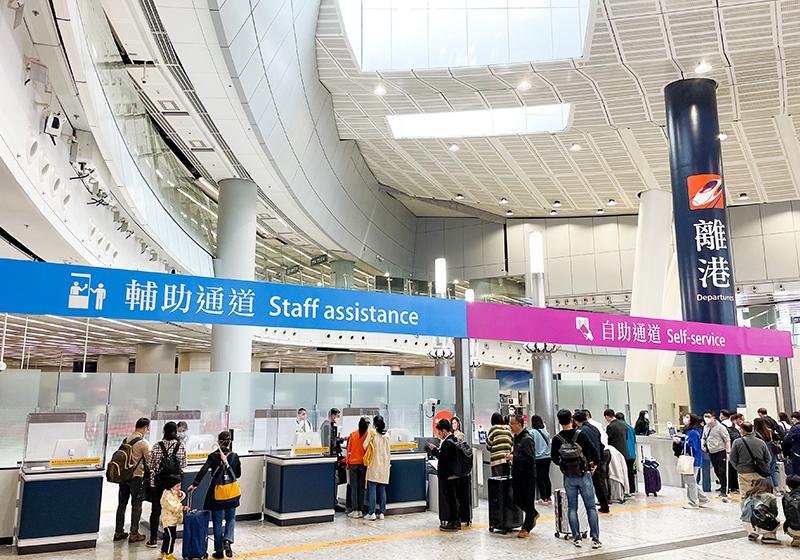
- Time Budget: In 2026, smart gates have sped this up, but you should still arrive at least 45 minutes before departure. Gates close strictly 15-20 minutes before the train leaves.
Popular Short-Haul Schedules
- HK to Shenzhen North / Futian: The "commuter" line. Trains depart roughly every 15-20 minutes. It is so frequent that many travelers don't even check the schedule; they just show up and buy the next ticket.
- HK to Guangzhou South / Guangzhou East:
- Guangzhou South: The main hub, with hourly departures. Fast (45-60 mins) but located far from the city center.
- Guangzhou East: The savvy traveler's choice. It brings you directly into the Tianhe CBD. Though the train takes longer (~1.5 hours), you save time on the final leg.
Long-Haul Routes & The New Sleepers
- HK to Beijing/Shanghai:
- Daytime G-Trains: These take about 8-11 hours. A long day in a chair, even a comfortable one.
- The "Sunset-Sunrise" Sleepers: In mid-2024, the old "through trains" were replaced by high-speed sleepers (D909/910 etc., often upgraded to G-series speeds). These depart HK in the evening and arrive in Beijing or Shanghai early the next morning.
- Note: Second Class seats are available on these sleeper trains for those on a tight budget, but sitting upright all night is grueling.
A Note on Seasonality
The China bullet train second class route network is rigid, but the frequency is elastic. During Chunyun (Spring Festival), Golden Week (Oct 1-7), and Hong Kong public holidays (Easter, Christmas), schedules are reinforced, but tickets sell out seconds after release. Always check the MTR High Speed Rail app or Trip.com for the specific date's schedule.
Ticket Prices and Booking Tips from Hong Kong
Navigating the China bullet train second class price landscape requires understanding the new market mechanics introduced recently.
Understanding Dynamic Pricing in 2026
Gone are the days of flat-rate tickets. China Railway now employs a dynamic pricing model similar to airlines.
- Peak Demand: A Friday evening train to Guangzhou will cost roughly 10-20% more than a Tuesday morning train.
- Early Bird: Booking 10-14 days in advance can sometimes yield discounts of up to 20-30% on specific trains (usually the very early or very late departures).
- Rough Price Guide (HKD - Estimates):
- HK -> Shenzhen Futian: ~$75 - $90 HKD
- HK -> Guangzhou South: ~$230 - $260 HKD
- HK -> Xiamen: ~$300 - $350 HKD
- HK -> Beijing: ~$1,100 - $1,300 HKD
How to Buy Tickets (The "Paperless" Era)
You do not need to queue at a counter. In fact, you shouldn't.
Where to Book:
- Official: Railway 12306 App. The official app has an English version. It is fee-free but can be glitchy with foreign credit cards and navigation.
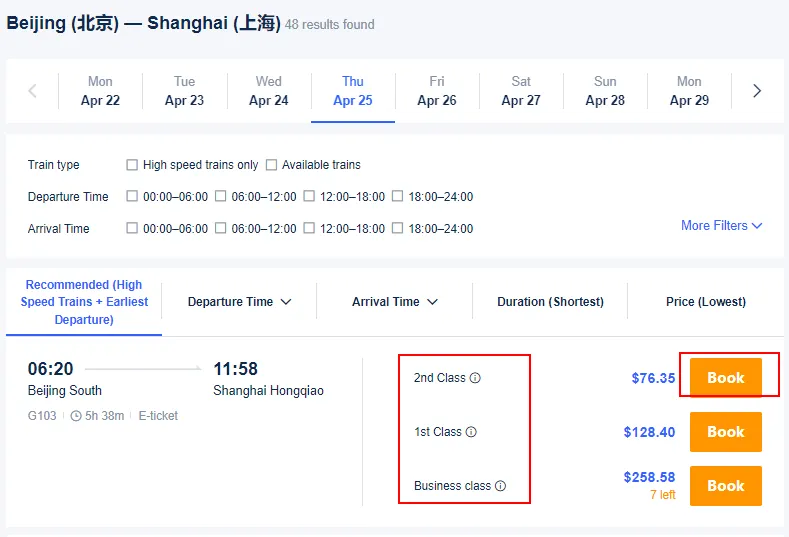
- Agents: Trip.com. For English speakers, this is the gold standard. The interface is intuitive, customer service is 24/7, and they accept all major credit cards and Apple Pay. Here’s how:
1. Head to the "China Train Tickets" page on Trip.com.
2. Enter your departure and arrival cities, travel date, and the number of passengers.

3. Choose your train type (G/D/C/Z/T/K) and seat class.
4. Enter your passport details (make sure they match your actual passport!).
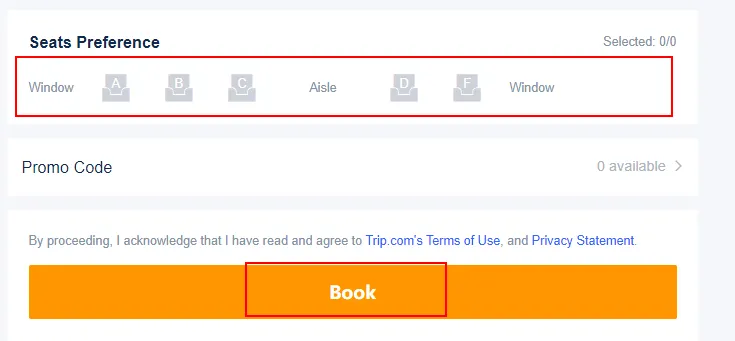
- Pay with an international credit card or a digital wallet (Trip.com accepts most).
- You'll receive the e-ticket via email, and pick up the physical ticket at the train station before boarding (use your passport at the ticket office or a self-service ticket machine).
Identity Documents:
- Paperless Entry: Your Home Return Permit (for HK/Macau residents) or Passport is your ticket. You simply scan your ID document at the gate to enter.
- Troubleshooting: If you are using a passport, ensure you use the "Manual Lane" if the automatic gates reject your document.
New Features for 2026: Quiet Carriages and Food Delivery
The China High-Speed Rail experience is constantly evolving. Two features have significantly upgraded the Second Class experience.
Quiet Carriages (Silent Cars)
Targeting the complaint of noise, China Railway has rolled out "Quiet Carriages" on many Fuxing trains (often Carriage #3 or #4).

China's high-speed trains roll out 'quiet carriage' service - CGTN
- The Rules: In this carriage, you must obey the silence. No phone calls (you must exit to the vestibule), devices must be muted or used with headphones, and chatting must be whispered.
- How to Book: When booking on 12306 or Trip.com, look for the "Quiet Carriage" checkbox or tag. It usually costs the same as a standard Second Class seat. It is highly recommended for business travelers.
Food Delivery to Your Seat
This feels like magic. You are no longer limited to the pre-packaged microwave meals in the dining car.
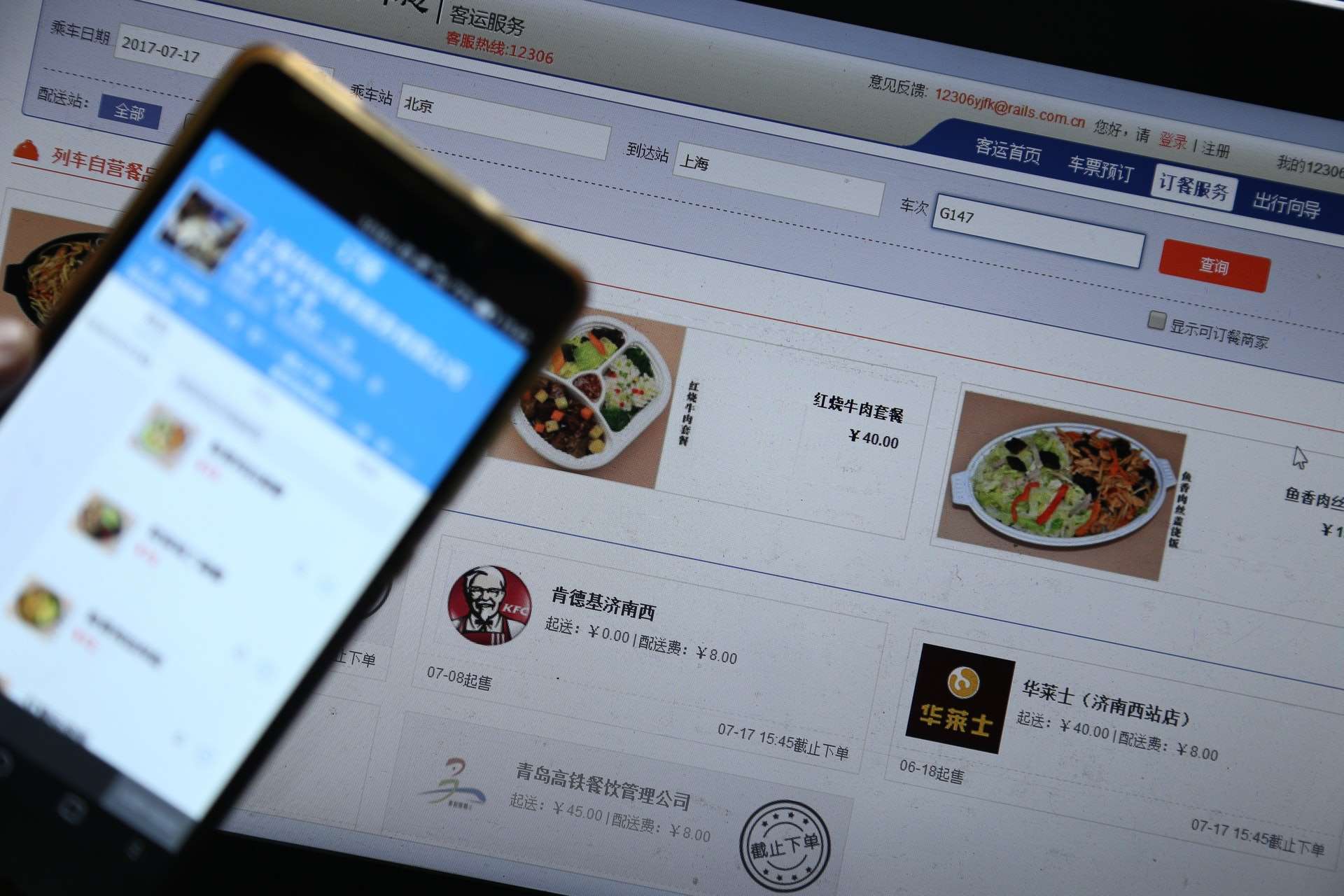
Source: HK01
- How it Works:
- Connect to the train Wi-Fi or use your data.
- Open the 12306 App and select "Catering > Order Food".
- Enter your train number and departure date.
- You will see a list of restaurants available at upcoming stations (e.g., McDonald's, KFC, local dim sum, spicy beef noodles).
- Place your order at least 1 hour before the train reaches that specific station.
- The Delivery: When the train stops at that station, a delivery runner hands the food to the train conductor, who then walks it to your seat (Carriage X, Seat Y).
- Cost: You pay the restaurant price plus a small delivery fee (approx. 8 RMB).
[8% Off] Discover China's Top Hotel Picks!
Summary: Is Second Class Right for Your Trip?
China bullet train Second Class is the "Goldilocks" option for Hong Kong travelers. It avoids the exorbitant cost of Business Class while elevating you far above the chaos of old-school travel. It is affordable, efficient, and—thanks to innovations like the Quiet Carriage and seat-side food delivery—increasingly comfortable.
Whether you are racing to a meeting in Shenzhen or embarking on a grand tour to Beijing, Second Class offers a reliable, modern, and distinctly Chinese travel experience.
Ready to explore the Mainland? Download the Trip.com app today, check the latest schedules, and book your window seat (F) before it’s gone!
Frequently Asked Questions (FAQ)
1. How much luggage can I take on China bullet train second class?
In 2026, regulations are strictly enforced. Adults can carry 20kg of luggage for free. The sum of the length, width, and height must not exceed 130cm (roughly a standard 24-inch suitcase). 26-28 inch bags often fit in the large closets at the end of the carriage.
2. Are there toilets in Second Class?
Yes. Each carriage typically has a washroom area. You will usually find one Western-style sit-down toilet and one squat toilet, plus a separate washbasin area with a large mirror. While they are cleaned regularly, it is always a smart travel move to carry your own packet of tissue and hand sanitizer.
3. Can I change my Second Class ticket to First Class on board?
Yes, this is known as "Bu Piao" (supplementing the ticket). If you find Second Class too crowded, you can find the conductor (usually in the middle carriages or dining car) and ask to upgrade. If seats are available, you simply pay the price difference via WeChat Pay or Alipay.
4. Do Second Class seats have charging ports?
Yes. Look under your seat cushion. On the three-seat row (A, B, C), the outlets are located between seats A&B and B&C. On the two-seat row (D, F), the outlet is between the two seats. Most 2026 trains also feature USB ports on the seatback in front of you.


已出售435580